Engineered wood, explained — plywood, latte, MDF & HDF
أبلكاش، لاتيه, MDF, HDF — you hear these words at every carpenter, but what are you really paying for? A plain-language guide to engineered wood and where each one is the smart choice.
Why engineered wood exists
Solid wood is beautiful but it moves, it warps, it is limited in width, and a wide solid board is expensive. Engineered boards were invented to fix exactly that: by breaking wood down into veneers, strips or fibres and gluing it back together, you get large, flat, stable sheets at a fraction of the cost — and far more predictable behaviour. They are not "fake wood". They are wood, re-engineered for a specific job.
Plywood (أبلكاش) — strong and light
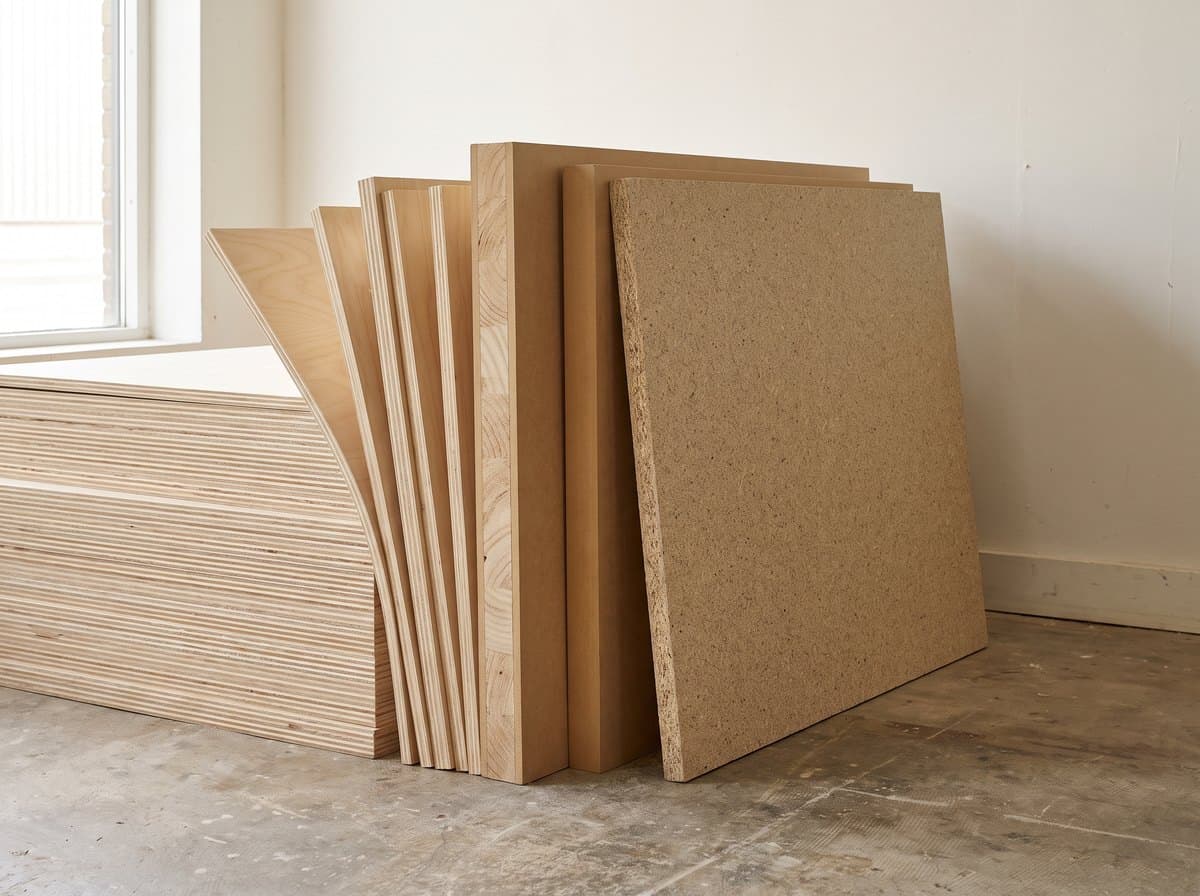
Plywood is built from thin layers of real wood veneer glued with their grain crossing at right angles, layer over layer. That cross-grain trick is what makes it so strong and stable for its weight — it resists splitting and barely moves. It is the workhorse for cabinets, drawer boxes, curved forms and structural work. Buy by grade: cheap plywood can hide voids inside; marine and birch plywood are the premium end.
Blockboard / Latte (لاتيه) — rigid for long spans
Blockboard has a core of solid wood strips standing side by side, sandwiched between two veneers. That core makes it light yet very rigid along its length, so it resists sagging — which is why it is the classic choice for long shelves, doors, and table tops. Its weakness is the edge: the strip ends do not hold screws or fine edge detail as well as plywood, so edges are usually banded or framed.
MDF & HDF — smooth, for paint and detail
MDF (medium-density fibreboard) is wood ground to fine fibre and pressed with resin into a perfectly smooth, grain-free board. It has no direction, so it routes and CNC-carves into crisp detail and takes paint like glass — the go-to for painted doors, panelling and shaped work. HDF is the same idea pressed denser and harder; it is what sits under laminate flooring and inside moulded door skins. Both are heavy, both hold screws poorly on the edge, and both must be kept dry.
Chipboard (خشب مضغوط) — cheapest, know its limits
Chipboard (particle board) is wood chips and sawdust bound with glue — the cheapest board there is. Wrapped in melamine it becomes the white/wood-look flat-pack furniture everyone owns. Used dry, flat and well-supported it is perfectly fine. But it is weak, holds screws poorly, and the moment water gets in it swells permanently and never recovers. Never put it under a sink.
The honest rule
There is no "best" board — only the right board for the job. Plywood when you need strength and screw-holding; blockboard for long rigid spans; MDF for smooth painted detail; HDF for hard wearing surfaces; chipboard for cheap, dry, flat work. And one enemy unites them all: moisture. Seal the edges, keep them dry, and engineered wood will outlast your expectations.
See every wood in the library
Browse the woods