Hardwax oils — the finish that lets wood feel like wood
Premium furniture quietly abandoned thick glossy varnish for a jar of oil and wax — and for good reason. What hardwax oils actually are, why they won, how to apply them properly, and where they honestly fall short.
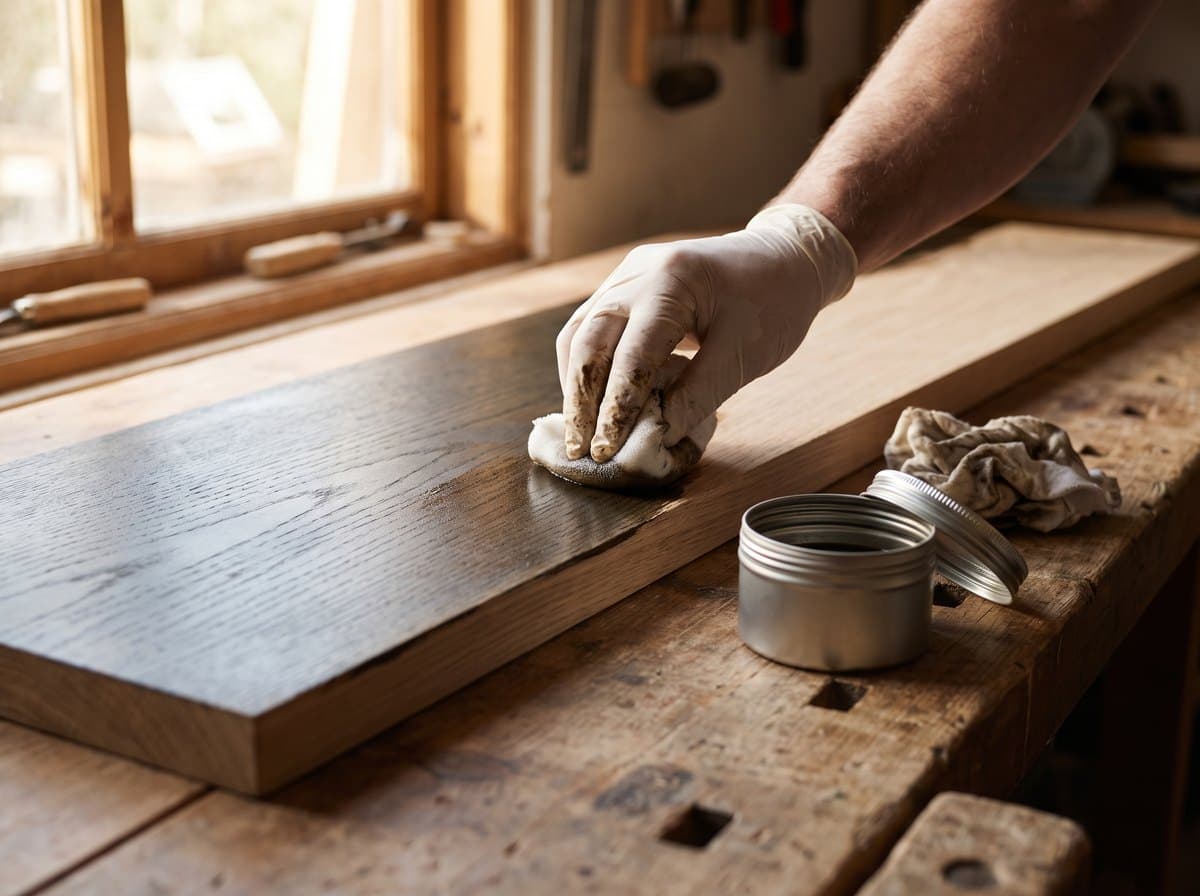
What is actually in the tin
A hardwax oil is exactly what the name says: natural drying oils blended with hard natural waxes, thinned with a small amount of solvent so it spreads easily. The oils are the kind that harden by reacting with air — linseed, tung, sunflower, soya, thistle. The waxes are the hard plant waxes: carnauba (from a Brazilian palm leaf) and candelilla, both far harder than beeswax. The solvent is usually a dearomatised white spirit or isoparaffin — the low-odour kind — and there is a pinch of siccatives, which are simply drying accelerators. That is the whole recipe. No plastic resin dissolved in the mix, no thick film waiting to form.
The two halves do two different jobs. The oil soaks into the wood and polymerises — it reacts with oxygen and hardens *inside* the fibres, like a resin curing within the top layer of the wood itself. The wax is too heavy to travel deep, so it stays at the surface, where it forms a whisper-thin, water-repellent, slightly satin skin. Protection from within, repellency on top — that division of labour is the entire idea.
One label term worth knowing: "high solid". Classic hardwax oils were a good share solvent; high-solid versions carry more oil-and-wax and less solvent per litre. More of what you paid for stays in the wood, less evaporates into the room — which also means lower VOC emissions, one reason these finishes pass strict indoor-air standards.
Oil, film, or both — where hardwax oils sit
Every wood finish on earth belongs to one of two families. Penetrating finishes — plain linseed oil, tung oil — soak in and leave almost nothing on top. The wood looks and feels wonderful, but the protection is modest and the upkeep endless: pure oils want re-oiling again and again, and they resist water poorly. Film finishes — polyurethane (the varnish or "lacquer" every workshop in Amman knows), lacquers, water-based PU — do the opposite. They build a continuous plastic sheet over the wood. Excellent armour, but you are now touching plastic, not timber, and when that film scratches or peels there is no small fix: you strip and refinish the whole surface.
A hardwax oil is the deliberate hybrid: it penetrates like an oil and leaves only a micro-thin wax skin instead of a plastic sheet. You get far more protection than a pure oil, far more repairability and naturalness than a film — and you give up some of the film's brute resistance. Every strength and weakness in the rest of this article flows from that one trade.
The look is also a category of its own. Because there is no thick film bending the light, the surface reads matte to soft-satin, the grain stays open and tactile, and your hand feels wood — its warmth, its texture, even its pores — not a glass coating over wood. Finishers call it "natural effect". Once clients feel the difference on two sample boards, most never choose the plastic one again.
Why premium furniture switched
Walk through any serious furniture maker's showroom today — Europe, Japan, the Gulf — and the tables are matte. Twenty years ago they were gloss. Three forces drove the change. First, taste: the market moved towards honest materials, and a thick shiny film started reading as cheap precisely because it hides the wood. Second, health and regulation: hardwax oils are low-VOC, and the leading products carry certifications that film finishes rarely match — safe for children's toys under the European toy-safety standard EN 71-3, resistant to saliva and sweat under DIN 53160, and in several products certified food-contact safe, which is why they finish cutting boards and kitchen worktops.
Third — and for a workshop this is the decisive one — serviceability. A dining table is not a museum piece; it will be scratched, ringed and worn. On a film finish that damage is a death sentence for the whole surface. On a hardwax oil it is a fifteen-minute repair, as we will see below. Premium makers switched because they could finally promise clients a finish that ages and can be healed, instead of one that is perfect until the day it is ruined.
The names you will meet in this world: Osmo Polyx-Oil (the German original of the modern category), Rubio Monocoat (the Belgian one-coat system), Fiddes Hard Wax Oil (the Welsh value favourite), and Borma Wachs from Italy, among others. They differ in chemistry details and price, not in the basic idea.
How to apply one — thin is everything
Ninety percent of hardwax-oil failures are one mistake: applying it like paint. This finish is not meant to sit on the wood in a layer — it is meant to be pushed *into* it. The rule that governs everything: thin, thinner than feels reasonable. A litre of a quality hardwax oil should cover roughly 20–24 m² per coat; if you are getting 10, you are flooding it, and a flooded coat stays sticky for days and may never harden properly.
The classic two-coat method: sand cleanly to around 120–150 grit (finer polishes the surface closed and blocks penetration), remove every trace of dust, then spread a thin coat with a flat applicator pad, a natural-bristle brush, or a cloth, working with the grain in small areas of about one square metre at a time. After a few minutes, wipe or buff off everything the wood has not drunk — a white non-abrasive pad works beautifully. Let it dry overnight (8–12 hours in a warm room), then repeat with an even thinner second coat.
The one-coat systems work differently. Rubio Monocoat's Oil Plus 2C bonds molecularly with the top wood fibres and is designed for a single coat; its "2C" is a second component — an accelerator mixed in at about 3:1 — that cuts curing from weeks to about a week. Whichever brand you use, learn the difference between drying and curing: dry to the touch is hours, but full chemical hardness takes two to three weeks for classic hardwax oils. Use the piece gently in that window — no wet mopping, no heavy objects parked on it, coasters under everything.
Applying it in Jordan — the dry-heat rulebook
Most application guides are written for a damp European workshop at 18 °C. Amman in summer is 32 °C at maybe 25 % humidity, and that changes the job. Heat and dry air make the solvent flash off fast — sometimes in minutes — so the working window before the oil gets tacky shrinks sharply. The fixes are simple discipline: work early morning or evening, keep the tin and the piece out of direct sun, shrink your working sections from one square metre to half of one, and never let an edge dry before you have blended the next section into it, or you will see overlap marks in raking light.
The same dryness is a gift on the other side of the process: between-coat drying that takes overnight in a wet climate can be comfortably done here, and dust — the enemy of every finish — settles fast in still air, so finish your sanding, leave the room to clear for half an hour, then oil. One caution that matters more in our heat than anywhere: keep a gentle airflow but no wind. A breeze through the workshop door carries dust onto a tacky surface faster than you can wipe it.
And the safety rule that must be said plainly, because our climate makes it worse: rags soaked with drying oils self-ignite. The same oxidation that hardens the oil in the wood generates heat in a bundled rag, and on a 35 °C afternoon that heat has a head start. Never leave used cloths or pads in a pile or a bin. Spread them flat outdoors to dry stiff, or drown them in a sealed container of water. Every experienced finisher knows a workshop-fire story; do not become one.
Living with it — maintenance and the killer feature
Day to day, a hardwax-oiled surface asks very little: dry dusting, a well-wrung damp cloth when needed, and mild soap — ideally the maker's own wood soap, which leaves a trace of oil behind instead of stripping it. Avoid aggressive cleaners and anything with ammonia or vinegar; they eat the wax. Once a year or two on furniture (more often on floors and worktops), a thin wipe of maintenance oil — Osmo's Liquid Wax Cleaner or Rubio's Universal Maintenance Oil are the typical examples — refreshes the surface without any sanding at all. The finish never builds up, never yellows into a crust, never needs stripping.
Then there is the feature that sells the category: spot repair. A scratch, a water ring, a worn patch by the door handle — you lightly sand just that area, wipe on a little of the same oil, buff, and walk away. The repair blends invisibly, because there is no film to leave a witness line around the patch. Fifteen minutes, no professionals, no dismantling. Compare the polyurethane version of the same accident: the film is breached, moisture creeps under it, the damage spreads whitish and lifted, and the honest fix is sanding the entire top back to bare wood.
This is the deepest difference between the two philosophies. A film finish is at its best on day one and degrades towards a full refinish. A hardwax oil starts good and is maintained at good, indefinitely, in small cheap increments. For furniture meant to serve a family for decades, that maths is hard to argue with.
The honest limits — where polyurethane still wins
A wood library that only praises would not be worth reading, so here are the limits. Standing liquids: a hardwax oil repels water, it does not seal it out. A spill wiped within minutes is nothing; a glass left overnight can print a ring. Heat: a hot pot straight from the stove will mark the surface white within a minute — the wax migrates and traps moisture. Trivets and coasters are not optional. Alcohol and strong cleaners can dull the sheen. And the finish reaches full toughness slowly — those two to three weeks of curing demand patience that a sprayed lacquer does not.
So when does the film finish still deserve the job? A restaurant tabletop scrubbed with chemicals twenty times a day. A bathroom vanity that lives wet. A bar counter swimming in spilled drinks. Rental-property floors that will get zero maintenance. In honest terms: wherever abuse is guaranteed and care is not, the plastic film's brute resistance wins, and a good two-component PU or a conversion varnish is the right professional answer.
For almost everything else in a home — dining tables, desks, beds, shelving, wardrobes, doors, most floors — the hardwax oil's combination of natural look, natural feel, safety certifications and lifetime repairability is simply the better total package. That is not marketing; it is why the premium end of the industry moved, and stayed.
An engineer's note
I was trained on finishing lines where wood disappeared under sprayed films, and I understand the appeal: a film is predictable, fast, and forgiving of a rushed schedule. But a finish is a promise about the future of a piece, and the two promises are different. The film promises perfection until failure. The oil promises a surface that lives with you — that takes a mark, accepts a repair, and looks better rubbed by ten years of hands than it did new. For furniture I build to outlast me, I know which promise I would rather sign.
Two pieces of hard-earned advice. First: never trust the finish, test it. Oil a sample offcut of the actual wood — the same board, the same sanding grit — before touching the piece, because oak, walnut and pine each drink differently, and colour shifts you did not expect show up on the sample, not on the client's table. Second: buy the small tin. A hardwax oil goes so much further than people expect — a dining table needs perhaps 100–150 ml per coat — and a litre tin, once opened, slowly skins over. The small tin used fresh beats the big tin used stale, every time.
And if you take one sentence from this whole article, take this one: apply it thin, wipe off the excess, and let time do the hardening. The finish rewards patience the way wood itself does.
See every wood in the library
Browse the woods