Wood glue, without the myths — which glue for which job
White, yellow, D3, polyurethane, epoxy — the glue shelf is confusing, and half of what you hear about it is myth. A wood engineer's field guide to choosing the right adhesive for furniture and joinery in Jordan.
Start with the fact that changes everything
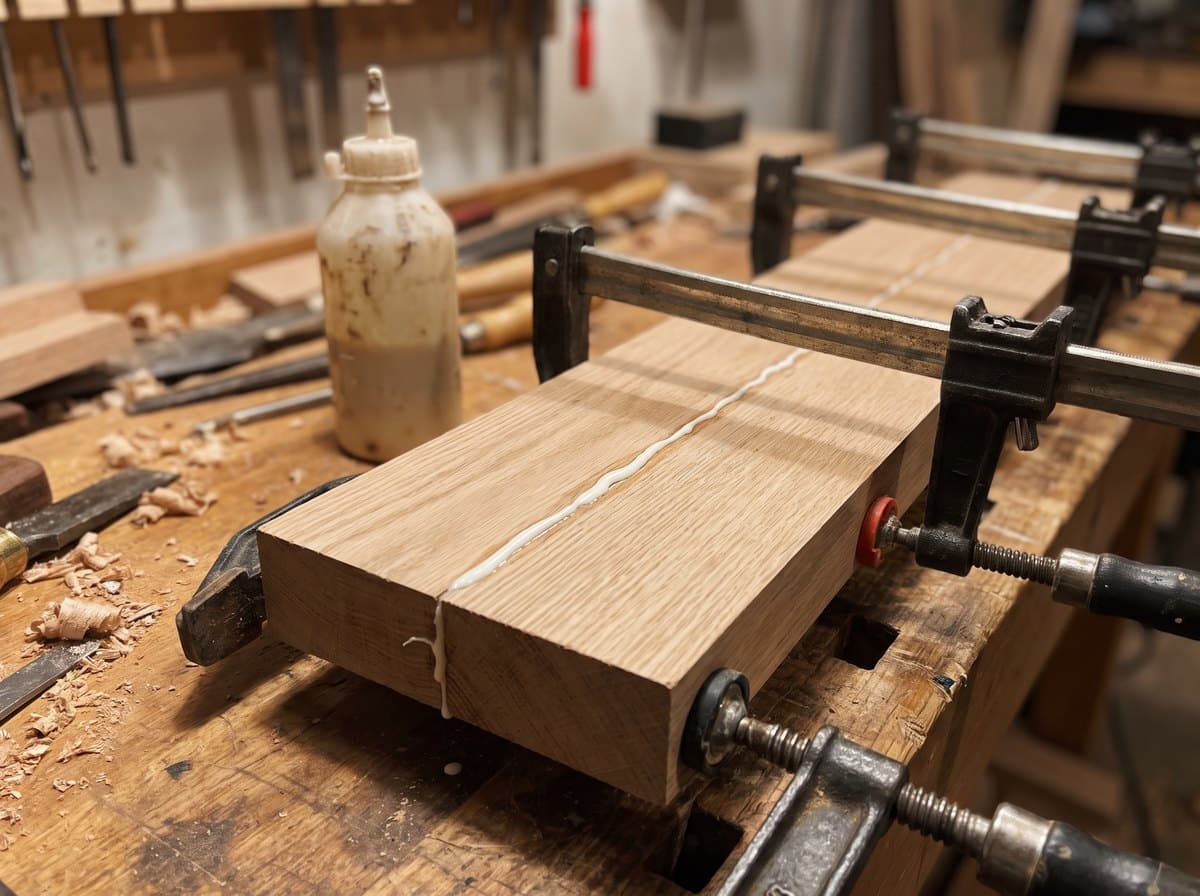
In a properly made joint, modern wood glue is stronger than the wood itself. Break a well-glued long-grain joint and the wood splinters beside the glue line — the glue line holds. This is not marketing; it is repeatable in any test lab, with even the cheapest white glue.
That fact flips the whole conversation. When a joint fails, the culprit is almost never "weak glue" — it is a starved joint, a sloppy fit, a dusty or oily surface, too little clamp pressure, glue past its shelf life, or the wrong glue for the conditions (heat, water). Buying a more expensive bottle will not rescue a badly fitted joint.
So the real question is never "which glue is strongest?" They are all strong enough. The real questions are: how much water and heat will this joint see, how much working time do I need, and does the joint fit well enough for the glue to do its job? The rest of this guide answers exactly that.
PVA — the everyday hero, and what D2, D3, D4 really mean
PVA — the familiar white glue, and its yellow "carpenter's" cousin — deserves its place as the default. It is cheap, non-toxic, easy to clean with water, and in a good joint it is stronger than the wood. Roughly nine out of ten furniture joints need nothing else.
Those D-codes on the bottle are not marketing tiers — they are a European standard (EN 204) for water resistance. D2: interior work with only brief, occasional dampness — most basic white glues. D3: withstands repeated moisture and humidity — kitchens, bathrooms, and honestly the sensible minimum for furniture. D4: waterproof enough for exterior joinery and pieces that stay wet for days, often a PVA with a hardener added, or you step up to polyurethane.
Know its honest weaknesses. PVA creeps: under a constant heavy load the glue line can slowly slide a fraction of a millimetre over the years, which is why bent laminations and heavily stressed structural joints deserve a different glue. It softens with heat. And it needs warmth to cure: below roughly 10 °C the glue dries chalky-white and weak — remember that in an unheated Amman workshop in January. Clamp an unstressed joint 30–60 minutes, a stressed one for 24 hours; leaving clamps on for two days does not make the joint stronger — that is a myth.
The specialists — PUR, epoxy, hide glue, CA, contact cement
Polyurethane (PUR) cures with moisture instead of drying, which makes it genuinely waterproof and happy to bond slightly damp wood — and metal, stone and plastics too. It foams as it cures; more on that trap in the next section. It is the serious choice for exterior work and mixed materials, but it stains skin, and squeeze-out must be left to harden and then pared off.
Epoxy is two parts you mix, and it is the only common adhesive that is truly structural across a gap — it needs almost no clamp pressure and does not care about a loose fit. Waterproof, bonds nearly anything, and slow versions give you all the working time in the world. The price is cost, mixing discipline and cure time. Hide glue — the traditional animal glue (الغراء الحيواني) that held together every piece of antique furniture you have ever admired — has one superpower no modern glue offers: it is reversible with heat and water, and new glue sticks to old. That is why restorers and instrument makers refuse to give it up. Its weakness is the same thing: heat plus moisture will undo it.
CA ("super glue") is for the small and instant: chips, splinters, hairline cracks, pen turning — with an activator spray it grabs in seconds, but it is brittle and hates shock loads. Contact cement (locally السيكوتين) is the laminate specialist: coat both faces, let them dry to the touch, press together once — instant, permanent grab over a huge area with no clamps. Perfect for HPL sheets and large veneers on boards; unforgiving, because there is no repositioning.
Two traps: end grain, and the gap-filling myth
End grain — the cut face at the end of a board — is a bundle of open straws. Put glue on it and the straws drink the glue away from the joint, leaving it starved. That is why an end-grain-to-end-grain joint reaches only a fraction of the strength of a long-grain joint, whatever glue you use. The workshop fix: "size" the end grain first with a thinned coat of glue, let it soak in a minute or two, then glue normally. The real fix is design — good joinery (mortise and tenon, dovetails, dominoes, splines) exists largely to convert weak end-grain contact into strong long-grain contact.
Now the myth. "Gap-filling" on a PVA bottle means gaps you can barely see — a tenth of a millimetre, not a badly cut tenon. And polyurethane's famous foam is the biggest trap of all: yes, PUR expands and fills the void, but that cured foam has almost no strength. A foamed gap looks solid and holds nothing.
If a joint genuinely has a gap you cannot close, only epoxy — ideally thickened — bridges it with real strength. Every other glue on the shelf wants two surfaces that touch. Better still: cut the joint again. Glue rewards accuracy; it does not replace it.
What industry glues the boards with — and what I saw in the lab at Sopron
Every engineered board in your house — plywood, MDF, chipboard, LVL beams — is held together by a different family of glues: urea-formaldehyde (UF) and its tougher melamine cousin (MUF), phenolic resins, and isocyanates (MDI — the industrial chemistry behind polyurethane glues). These cure in minutes inside heated presses at around 140 °C, not in hours under clamps. When you buy "moisture-resistant" green MDF or WBP plywood, what you are actually buying is a better adhesive.
Adhesive choice is not a detail — I measured this myself. For my master's thesis at the University of Sopron I produced LVL (laminated veneer lumber) beams from poplar and Turkey oak veneers, hot-pressed at 140 °C at 90 bar then 20 bar, and made identical layups with two adhesives: MUF (spread at 90 g/m², with a catalyst) against MDI. The MDI beams came out measurably denser, and in the weaker layups they carried a clearly higher bending load with better stiffness than their MUF twins. Same veneers, same press, same layout — the glue alone changed the numbers.
The takeaway for a buyer is simple: when a carpenter offers you two plywoods at two prices, part of that difference is the resin inside. Ask what the board is bonded with — interior UF board delaminates in a damp kitchen; a phenolic or melamine board shrugs it off. It is the least visible ingredient and one of the most decisive.
Heat and water — the Jordan test
Glue's two enemies are heat and water, and Jordan supplies both in its own way. Start with heat: standard PVA begins to soften and lose grip around 60–70 °C. That sounds far away until you remember what August does here — a closed car boot or a sun-baked balcony in Amman can reach exactly that range, and the Jordan Valley runs hotter. A glued chair delivered in a sealed van at noon in August, or a tabletop lamination left against a west-facing window, is genuinely sitting near the softening point of its glue.
Then water — not rain, but the kitchen sink, the bathroom vanity, the mop, the balcony winter. Any joint that will live near water deserves D3 as a minimum, and anything outdoors or repeatedly wet deserves D4, polyurethane or epoxy. And do not forget cold: the same Amman workshop that hits 40 °C in summer can sit below 10 °C on a January morning, where PVA cures chalky and weak. Warm the glue, the wood and the room — or wait for midday.
The practical rules for this climate: for anything that may travel in a hot vehicle or live near glass and sun, prefer a heat-tolerant glue (D4 PVA, PUR or epoxy) or design the piece so screws and joinery carry the load and glue is only the helper. For kitchens and bathrooms, D3 minimum. For pergolas, doors and outdoor furniture, D4, PUR or epoxy — and seal the wood too, because the best glue cannot protect a joint that stays soaked.
Engineer's note — what is actually on my bench
After the lab and years of workshop reality, my shelf is short. A quality D3 PVA does about ninety percent of everything — furniture, cabinets, panels. Polyurethane comes out for outdoor pieces and whenever wood meets metal or stone. Epoxy is my repair kit and my gap insurance. CA with activator lives in the drawer for chips and two-minute fixes. Contact cement only when laminate or big veneer is on the table. That is the whole arsenal; nobody needs twelve bottles.
Three habits matter more than any brand. Buy fresh and store cool — glue is a consumable with a shelf life of roughly a year once opened, and a hoarded five-litre jug that froze in January or cooked above the radiator in August is quietly dead. Spread on both faces, clamp until squeeze-out beads evenly, and resist the urge to over-tighten until the joint is starved. And test your doubt: glue two offcuts, wait a day, break them. The wood should fail, not the line — thirty seconds of testing beats an hour of forum debate.
What Sopron left me with is respect for the invisible. In the lab, two beams could look identical — same veneers, same press, same dimensions — and the numbers told them apart because of a glue you could not see. Furniture is the same. The glue line is the one part of a piece no client will ever look at, and it is holding everything they do look at together. Choose it like it matters, because it does.
See every wood in the library
Browse the woods