Wood joints — which joint for which job, honestly
Dowels, pocket screws, dovetails, mortise and tenon — every carpenter swears by a different one. Here is what actually holds furniture together, what is showing off, and why Jordan's dry air is the real test of every joint.
One rule decides everything: glue loves long grain
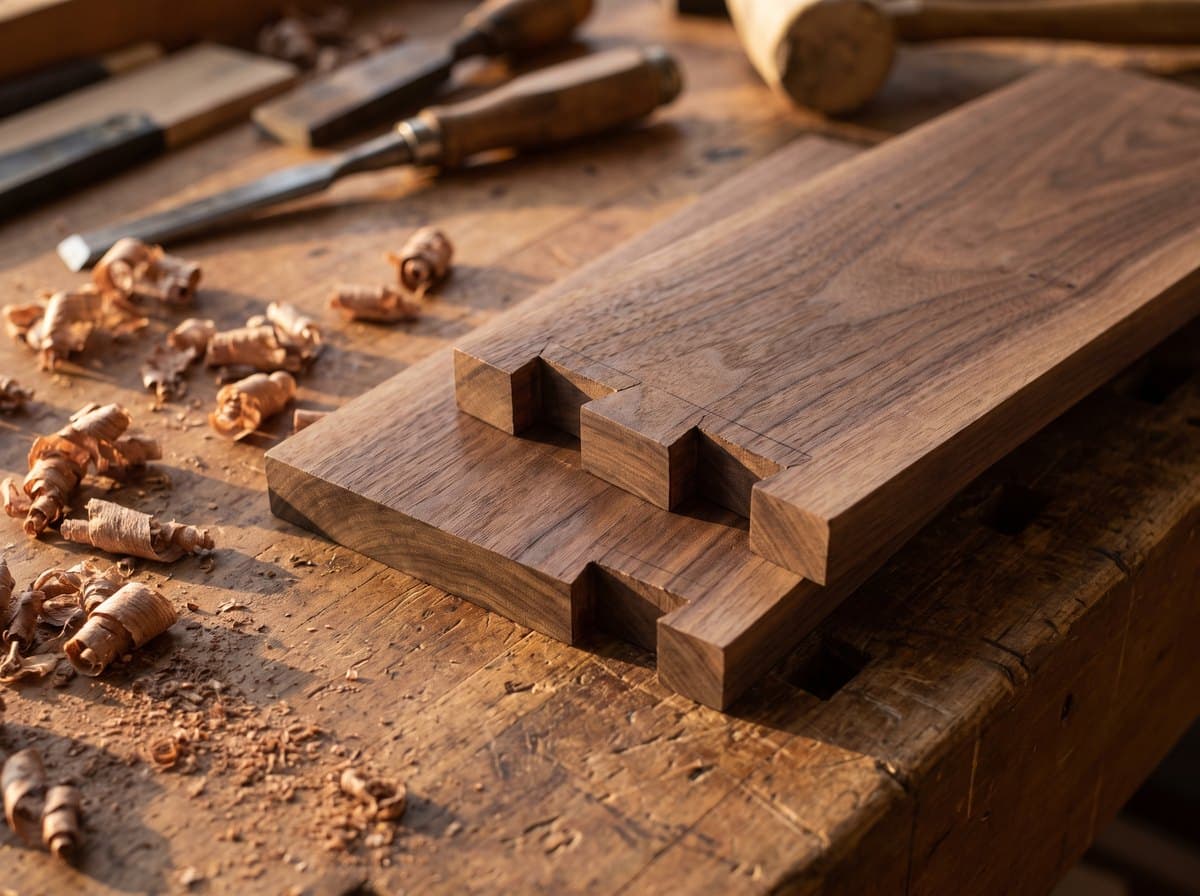
Before naming a single joint, learn the rule that all of them obey. Wood glue bonds brilliantly to the side of the grain — the long fibres running down a board — and badly to the cut ends. A long-grain glue line, done properly, is stronger than the wood around it: break the panel and it snaps beside the joint, not on it. An end-grain glue line manages only a fraction of that — roughly a third to a seventh of the strength — because the ends of wood are open tubes that drink the glue away from the surface.
That is why simply butting two boards together and gluing them (a butt joint) is not furniture-making — it is hoping. And it is why every "real" joint in this article is, at heart, the same trick wearing different clothes: cut the wood so that more long grain touches long grain, or add something mechanical — a screw, a dowel, a tenon, an interlocking pin — that carries the load the glue cannot.
Once you see joints this way, the whole subject stops being a catalogue of tradition and becomes engineering: how much long-grain contact does this joint create, and what mechanical lock does it add? Every choice below is judged by that question.
The fast family — screws, pocket screws, dowels, biscuits, dominos
Most modern furniture is held together by this family, and there is no shame in it — the shame is only in using the wrong member for the job. A butt joint reinforced with screws is fine for what nobody sees and nothing stresses: cleats, backs, internal blocking. Pocket screws (angled screws driven through a drilled pocket) are the honest workhorse of face frames and quick cabinet work — surprisingly strong in tests, fast, and ugly, so they belong where the pocket can hide.
Dowels (خوابير) deserve more respect than they get. Two or three well-fitted hardwood pins glued into matching holes create real mechanical strength — in published strength tests, multi-dowel joints landed in the same league as a mortise and tenon, ahead of pocket screws and far ahead of biscuits. Their weakness is precision: holes that do not line up perfectly make a joint that is stressed before it is even loaded. This is exactly where machines shine, which is why doweling is the backbone of factory furniture.
Biscuits — thin pressed-beech ovals glued into slots — are alignment tools, not strength tools. They keep two panels flush during glue-up, and that is their whole job; in every serious test they finish last. The Domino (a loose tenon cut by a dedicated machine) sits between dowels and a true mortise and tenon: genuinely strong, very fast, and the closest a portable tool gets to traditional joinery. The rule of thumb for the whole family: they buy speed, and you pay in either strength or hidden hardware. For a shelf or a painted cabinet, that trade is smart. For a chair, it is a slow-motion failure.
The classics — mortise & tenon, dovetails, box joints
The mortise and tenon (نقر ولسان) — a tongue on one piece fitted into a matching hole in the other — has held chairs, doors and tables together for about five thousand years, and every strength test still crowns it. It wins because it does both jobs at once: the tenon's cheeks give large long-grain glue surfaces, and the wood itself interlocks, so even if the glue one day dies, the frame still stands. Anywhere a joint is levered and racked for decades — a chair, a bed frame, a door — this is the joint. Not because it is traditional, but because the physics has not changed.
The dovetail (تعشيقة ذيل الحمامة) is a different specialist: wedge-shaped pins and tails that mechanically lock against pulling. Its natural home is the drawer front, which gets yanked thousands of times a year — the one place in furniture where pure pulling force attacks a joint daily. A good dovetail drawer survives generations of that. The box joint (finger joint, تعشيق أصابع) is its square-cut cousin: no locking wedge shape, but a huge amount of long-grain glue area, machine-friendly, and very strong.
Here is the honest part: on a box that is never pulled apart — a wall cabinet, a decorative crate — a dovetail is not doing structural work; it is doing marketing. It says "handmade, expensive" and clients love seeing it, which is a legitimate reason to want it. But if a maker tells you your bookshelf needs dovetails to survive, they are selling you labour, not strength. Pay for the classics where the forces demand them: chairs and doors get tenons, working drawers get dovetails or box joints, and everything else may not need the ceremony.
Cabinet joints — dados, rabbets, and why your kitchen holds up
Sheet materials — plywood, MDF, blockboard — changed the game. A cabinet side is stable and wide, so its joints do not fight wood movement; they fight gravity and racking. For that, two humble grooves do almost everything. A dado (مجرى) is a channel cut across a panel that a shelf sits into: the shelf is now supported by wood along its whole length, not by fasteners, which is why a dadoed shelf carries dramatically more weight than one merely screwed on. A rabbet (فرزة) is the same idea at the panel's edge — a step that receives a back panel or a top, locating it, squaring the whole box, and multiplying the glue area.
Almost every kitchen you have ever trusted is dados, rabbets, screws and a solidly fixed back panel — that thin back is secretly the brace that stops the whole box from twisting. Drawer boxes in good production work use a locking rabbet or machine-cut dovetails; in premium work, dovetailed solid-wood drawers on quality runners.
The lesson for a client: when you judge a cabinet, do not look for fancy corners. Open a drawer and look at how the bottom and back are held, and check whether shelves sit in grooves or hang on little plastic pins. That is where cabinet quality actually lives.
Miters — the joint everyone loves and wood hates
A miter — two pieces cut at 45 degrees meeting in a clean corner with no visible end grain — is the most requested joint in modern design and the least trustworthy one in the catalogue. Two reasons. First, a mitered face is half end grain, so the glue bond is mediocre from birth. Second, and this is the part almost nobody explains: wood moves across its width, and when a mitered board shrinks or swells, the 45-degree angle itself changes. In humid months the corner opens on the inside; in dry months it opens at the outer tip. That hairline gap you see in door trim and picture frames every winter is not bad workmanship — it is geometry doing what geometry does.
So a bare glued miter is only acceptable on small, light, stable things. Anywhere a miter must actually work — a waterfall table edge, a mitered box, a chunky frame — it needs reinforcement hidden inside: a spline (a strip of wood glued into a slot across the joint), hardwood keys, dominos or dowels buried in the faces. The reinforcement converts the joint from "end grain and hope" into long-grain glue surface plus a mechanical lock.
In Jordan the problem is sharper than in Europe, because our seasonal humidity swing is wide and our summers are very dry. A wide mitered corner in solid wood here is a promise you should only make with stable, well-dried timber, proper reinforcement, and a design that keeps the mitered parts narrow. When a client asks us for a seamless mitered look on a wide solid slab, part of our job is to say what the wood will do to it in two Augusts — and offer the veneer-over-stable-core version that will actually stay closed.
The Jordan factor — every joint fights our dry air
Wood never stops breathing. It swells as air gets humid and shrinks as air dries, almost entirely across the grain — a solid oak table top 100 cm wide can change by several millimetres between a damp winter and an Amman August. No finish stops this; finishes only slow it down. A joint, by definition, is a place where two pieces of wood meet — often with their grains crossing — which means one piece wants to move while the other holds still. Every joint is a negotiation with that fact.
This matters doubly here because most of our hardwood arrives from humid Europe. Timber kiln-dried and stored there sits at a higher moisture content than it will ever see again inside a heated Amman apartment in summer. Bring it in, build with it immediately, and the wood keeps shrinking after the piece is finished. If the joinery clamps it rigidly — a solid top glued and screwed hard to its frame, a panel glued into its grooves — the shrinking wood loses the fight the only way it can: it cracks. This is not a defect of the wood or the joint; it is a defect of the schedule.
The fixes are old and unglamorous. Let the timber acclimatise in the workshop — weeks, not days — before final machining. Design joints that hold tight in one direction and let go in the other: frame-and-panel doors where the panel floats loose in its grooves, table tops fixed with elongated screw slots or wooden buttons so the top can slide, breadboard ends pinned only at the centre. When you see a hairline gap appear at the edge of a floating panel in February and close again in summer, that is not failure — that is the design working exactly as intended.
What CNC changes — and what it never will
Our workshop runs CNC alongside hand tools, so we watch this shift from the inside. What CNC changes is the economics of precision. A well-fitted mortise and tenon or a dovetailed drawer used to cost hours of skilled handwork; a machine now cuts them in minutes, identically, fifty times in a row. Joints that were reserved for luxury pieces because of labour cost — not because of physics — are suddenly affordable. CNC also invented its own joinery dialect: slot-and-tab construction, interlocking flat-pack parts, and the little "dogbone" reliefs you see in inside corners, which exist because a spinning round bit cannot cut a perfectly sharp internal corner. That visible dogbone has even become an aesthetic — honest machine joinery that does not pretend to be handmade.
What CNC does not change is a single law in this article. Glue still loves long grain and mistrusts end grain. Wood still shrinks across a joint in a dry Amman summer, and a machine-cut miter opens exactly as fast as a hand-cut one. A CNC can cut a bad joint with beautiful precision — perfectly repeatable mistakes are still mistakes. The machine removed the skill barrier from cutting; it did not remove the knowledge barrier from choosing.
So the real modern workshop is not "CNC versus tradition". It is traditional joint-thinking, executed by whatever tool earns its keep: machine-cut tenons in a chair frame, hand-fitted where a machine cannot reach, doweled carcasses where speed matters, and a floating panel exactly where great-grandfathers would have put one.
The engineer's take — how I actually choose
After the training and the tests and the tradition, my choice comes down to three questions, asked in order. What forces will this joint see — steady weight, racking, or daily pulling? What will the wood do across this joint in Jordan's driest month? And who has to see it? Strength, movement, appearance — in that order, never reversed. Most bad furniture I am asked to repair got the order backwards: it was designed to look joined rather than to be joined.
My defaults, honestly stated: chairs and anything that racks get mortise and tenon, no debate — it is the one joint I will not substitute away. Working drawers get machine-cut dovetails or a locking rabbet. Cabinet boxes get dados, rabbets and a properly fixed back — and I will happily use pocket screws where they stay hidden, because false pride is not a structural material. Wide solid tops always get room to move; that rule has no exceptions, only future cracks. And a bare glued miter on anything larger than a picture frame gets a spline or it does not leave the workshop.
One last honest word. When a client pays extra for visible dovetails on a piece that does not structurally need them, they are not being cheated — they are buying craft made visible, the way one buys a mechanical watch in the age of the phone. That is a real and beautiful thing. My job is only to make sure you know which part of the price is physics and which part is poetry — and that the physics underneath is right either way.
See every wood in the library
Browse the woods